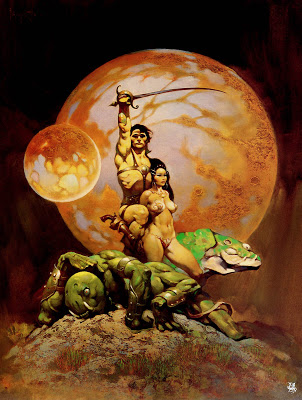
“I still live, and while I live I shall fight for Barsoom, and her people; the virtues of her noble sons and the glorious beauty of her daughters. Death, John Carter, must take me while I am facing the enemy with my sword in my hand!”
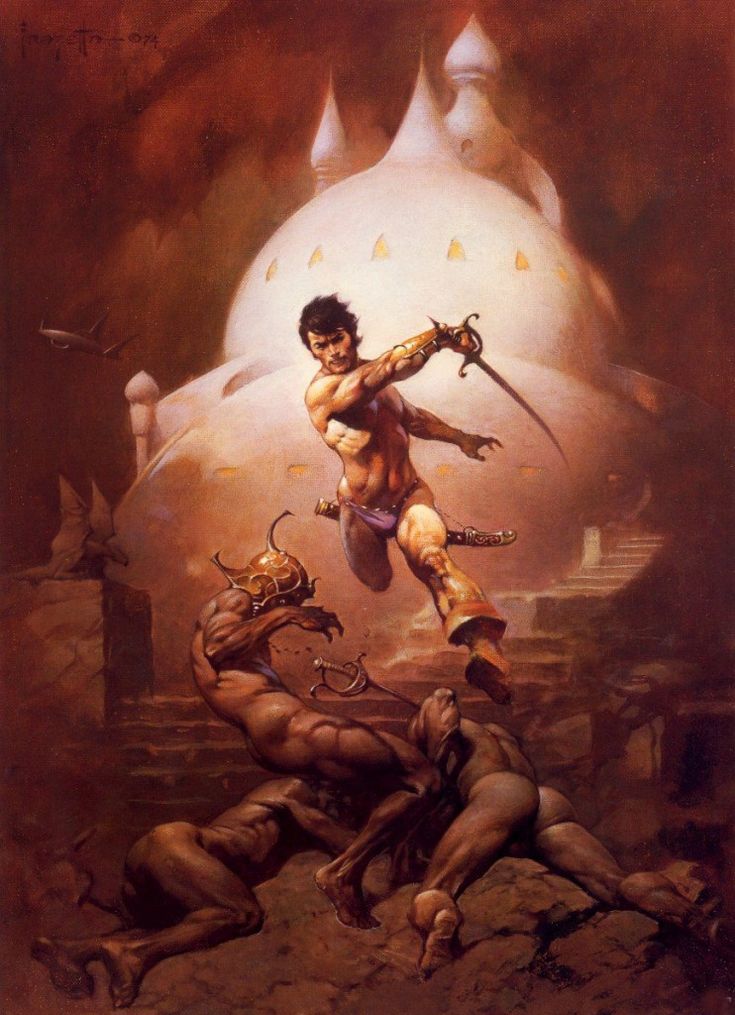
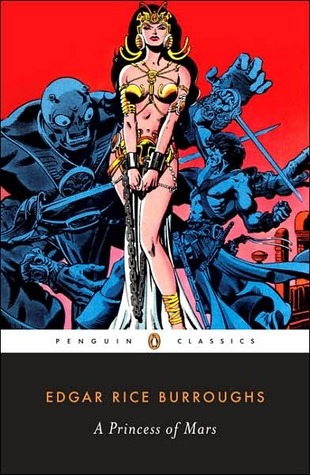
It wasn’t just Edgar Rice Burroughs’ words that first drew me into the world of Barsoom—it was Frank Frazetta’s artwork. His depiction of the beautiful Martian princess, Dejah Thoris, and the muscle-bound John Carter instantly intrigued me. As a fan of space opera with a touch of erotic fantasy, I was already primed for this sort of escapist adventure. There’s something captivating about the ordinary hero meeting unattainably beautiful women of royal stock. It’s part escapism, part power fantasy, but also a nod to the symbolic sacred power of women. Dejah Thoris, like many similar characters, is often dismissed today as an artifact of objectification, but to me, she represents the ideal traits of femininity—beauty, power, mercy, and compassion.
But beyond the beauty and brawn, A Princess of Mars is a seminal work of science fantasy, a pioneering adventure that captured the imaginations of countless readers, including legendary writers like Ray Bradbury and Arthur C. Clarke. Serialized in All-Story Magazine in 1912, it blends science fiction with the sweeping grandeur of planetary romance, transporting readers to a vivid, dying world where warlike tribes battle for dominance under a thinning Martian sky.
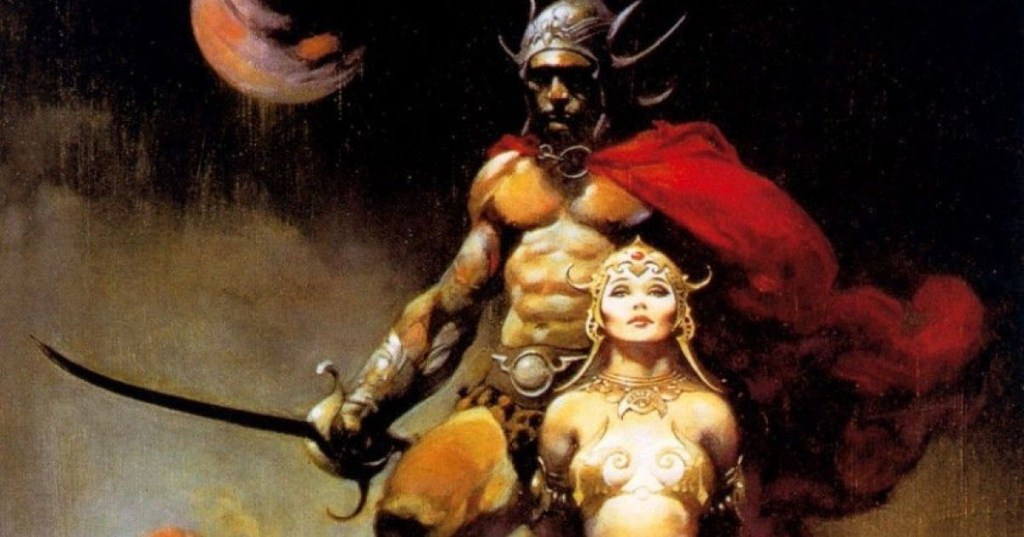
Plot Overview : Stranger in a strange land
The novel follows John Carter, a Confederate veteran of the American Civil War, who, while prospecting for gold in Arizona, is mysteriously transported to Mars—known to its inhabitants as Barsoom. There, the planet’s lower gravity grants Carter superhuman strength and agility, propelling him into the midst of a tribal war between the Green Martians (Tharks) and the humanoid Red Martians.
Carter, captured by the Tharks, rises through their ranks thanks to his martial prowess and leadership skills. He befriends Tars Tarkas, one of the Thark chieftains, and eventually becomes embroiled in the political and military conflicts of Barsoom. At the heart of the story is Carter’s romance with Dejah Thoris, the beautiful Princess of Helium, whom he rescues from captivity. The story builds to a thrilling climax, where Carter leads a horde of Tharks against the city of Zodanga, earning him the title of Prince of Helium. Yet, in one of the most bittersweet endings, Carter is torn from Barsoom and awakens back on Earth, unsure of what has become of his beloved princess.
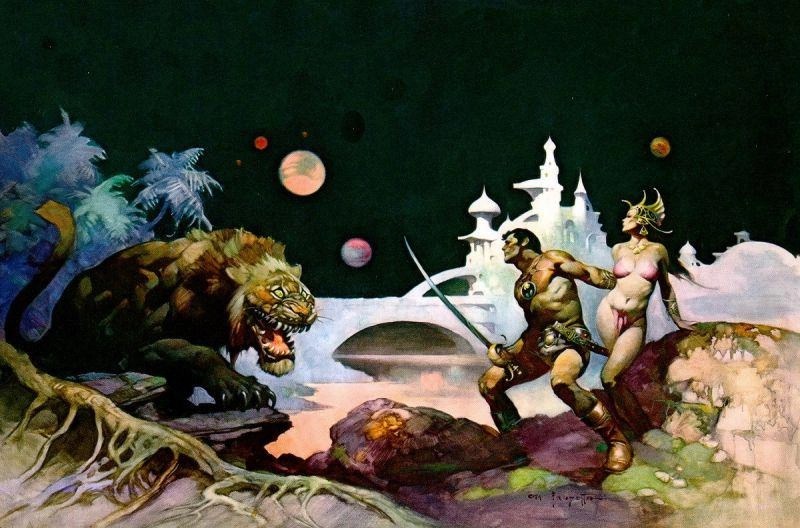
A planetery romance
At its core, A Princess of Mars is a love story. Yes, it’s filled with swashbuckling adventure and feats of heroism, but the emotional heartbeat of the novel lies in the relationship between John Carter and Dejah Thoris. The tragedy of their separation at the end of the book, where they are torn apart by the gulf of space and time, is one of the most moving conclusions I’ve encountered in fiction. It’s an ending that leaves you longing for more, a perfect blend of melancholy and mystery that stays with you long after you’ve finished reading.
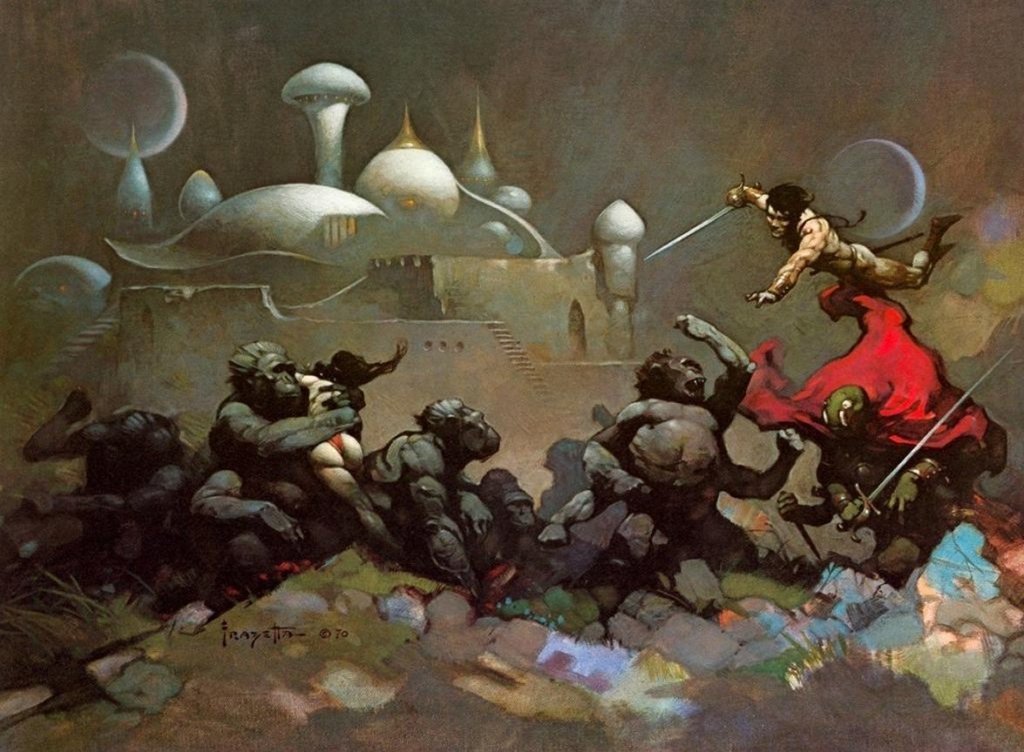
A Tour de Force of World-Building
What elevates A Princess of Mars above mere pulp adventure is Burroughs’ sheer creativity. The Martian landscape—its towering cities, floating fortresses, and vast deserts—comes alive through vivid descriptions. The races of Barsoom, from the warlike Green Martians to the more refined Red Martians, populate a world that feels both alien and deeply human in its conflicts. Burroughs’ Barsoom is a planet in decline, its atmosphere maintained artificially, its resources dwindling—a reflection of the early 20th-century fears about Earth’s own future. This vision was partly inspired by the astronomical theories of Percival Lowell, who believed Mars to be a dying world crisscrossed by canals built by an advanced but doomed civilization.
As a fan of H. Rider Haggard and Arthur Conan Doyle’s “lost world” novels, it’s clear Burroughs drew from these influences while carving out his own unique genre of “sword and planet.” There’s a raw creativity on display here, a whimsical sense of adventure that remains engaging and fun for modern readers willing to suspend disbelief. Although I consider Burroughs’ Tarzan of the Apes to be his best work, A Princess of Mars has a special charm that’s hard to resist.
Characters and Criticism: John Carter and Dejah Thoris
John Carter is the quintessential pulp hero—brave, honorable, and eternally optimistic. His rise from a slave of the Tharks to a leader among their tribes mirrors his journey to find love and purpose on Mars. Despite being a Confederate veteran, Carter is portrayed as a man of honor, one whose moral code transcends politics and race. However, this aspect of his background has drawn criticism in modern times, as has the book’s depiction of native Martians, which echoes imperialist narratives of the “civilized” hero saving the “savage” natives.
These critiques are valid and deserve attention, but context is key. Burroughs was a product of his time—a white American man writing in the early 20th century. His work reflects the cultural attitudes of that era. However, to dismiss A Princess of Mars solely on these grounds would overlook its value as escapism and power fantasy. Burroughs, after all, was a frustrated clerk yearning for adventure, and his creation of Barsoom was his way of living out those dreams.
Why A Princess of Mars Endures
Over a century after its publication, A Princess of Mars remains a thrilling and imaginative journey into an alien world. Its themes of honor, love, and survival resonate as much today as they did in 1912. Whether you’re drawn in by the romance, the action, or the sheer wonder of Barsoom, Burroughs’ vision continues to captivate. It’s a world where the stakes are always high, where heroes rise and fall, and where love can transcend even the vastness of space.
For modern readers willing to let go of realism and get swept up in the adventure, A Princess of Mars offers an escapist delight like no other. And for those of us who enjoy tales of beautiful princesses, daring heroes, and grand adventures, it stands as a timeless classic—a reminder of the power of imagination.
Final Thoughts
While it may not be as polished as Tarzan, A Princess of Mars holds a special place in my heart. It’s a whirlwind of creativity, action, and romance. And for all its flaws and outdated elements, I can’t help but admire its raw ambition. It’s the kind of book that asks you to dream big, and for that, it will always be one of my favorites.
 Fantasy : Swords and Sorcery