
In space no one can eat Ice Cream
Alien vs. Predator (AVP), directed by Paul W.S. Anderson and released in 2004, is often dismissed by fans of the Alien franchise as an abomination—a stain on the legacy of what many consider serious sci-fi. For me, however, AVP has always been a guilty pleasure—a fun, if derivative, entry in the series. Over the years, my appreciation for the film has only grown. While I understand the flaws that critics and fans point to, I believe that when taken on its own terms as a standalone monster movie, AVP is one of the most entertaining films ever made.
Adapted from a 1989 comic book series that brought together the eponymous creatures from the Alien and Predator franchises, AVP was the first film to officially merge these iconic worlds on the big screen. Anderson, known for his work on the Resident Evil series and the cult favorite Event Horizon, faced significant skepticism from fans, especially given his reputation for delivering action-packed but often bloodless adaptations. Yet, he brought a unique vision to AVP, weaving in influences from Aztec mythology, the writings of Erich von Däniken, and H.P. Lovecraft’s At the Mountains of Madness.

The film’s premise—set in a remote, ancient pyramid buried beneath the ice of Antarctica—pits scientists and mercenaries against both Xenomorphs and Predators in a deadly game of survival. While the decision to set the story on Earth in the present day and to aim for a PG-13 rating was met with disappointment by many fans, Anderson’s choices ultimately served the film’s broader appeal. The pyramid’s labyrinthine design, the cosmic horror elements, and the tense, creature-on-creature battles all contributed to a visually stunning and action-packed experience.
The cast, led by Sanaa Lathan as the formidable Lex Woods, delivers solid performances, with Lance Henriksen reprising his role in a new form as Charles Weyland, adding a touch of gravitas and continuity from the Alien series. The film’s sets, lighting, and visual effects are impressive, particularly in the scenes that showcase the epic battles between the Xenomorphs and Predators.
While AVP was met with generally negative reviews and criticized for its deviations from established lore and its lighter tone, it nonetheless grossed $177.4 million worldwide, proving that the concept of these two iconic creatures squaring off still held significant appeal. For all the scorn original Alien director Ridley Scott poured on this movie, it’s interesting to note that his later prequel, Prometheus, shares several plot elements with AVP—from the discovery of ancient alien temples to the involvement of the Weyland Corporation in uncovering humanity’s darkest secrets.
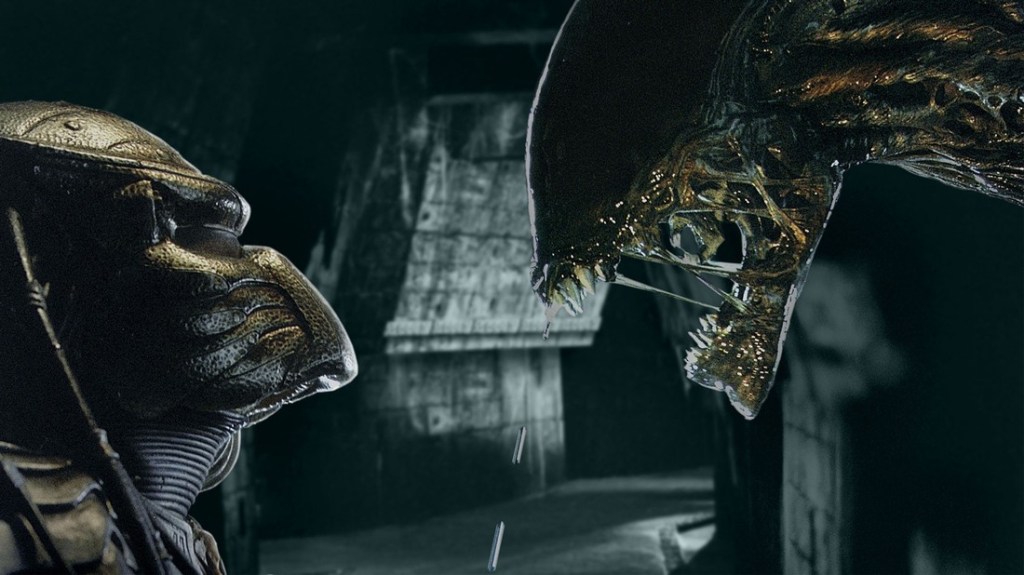
In the end, AVP might not be high art, but it is undeniably a lot of fun. For those willing to embrace it as a standalone monster movie rather than a canonical entry in either franchise, AVP offers an entertaining, if flawed, adventure that taps into the ‘what if’ factor of two legendary cinematic monsters facing off in an epic battle for survival.
 Fantasy : Swords and Sorcery